
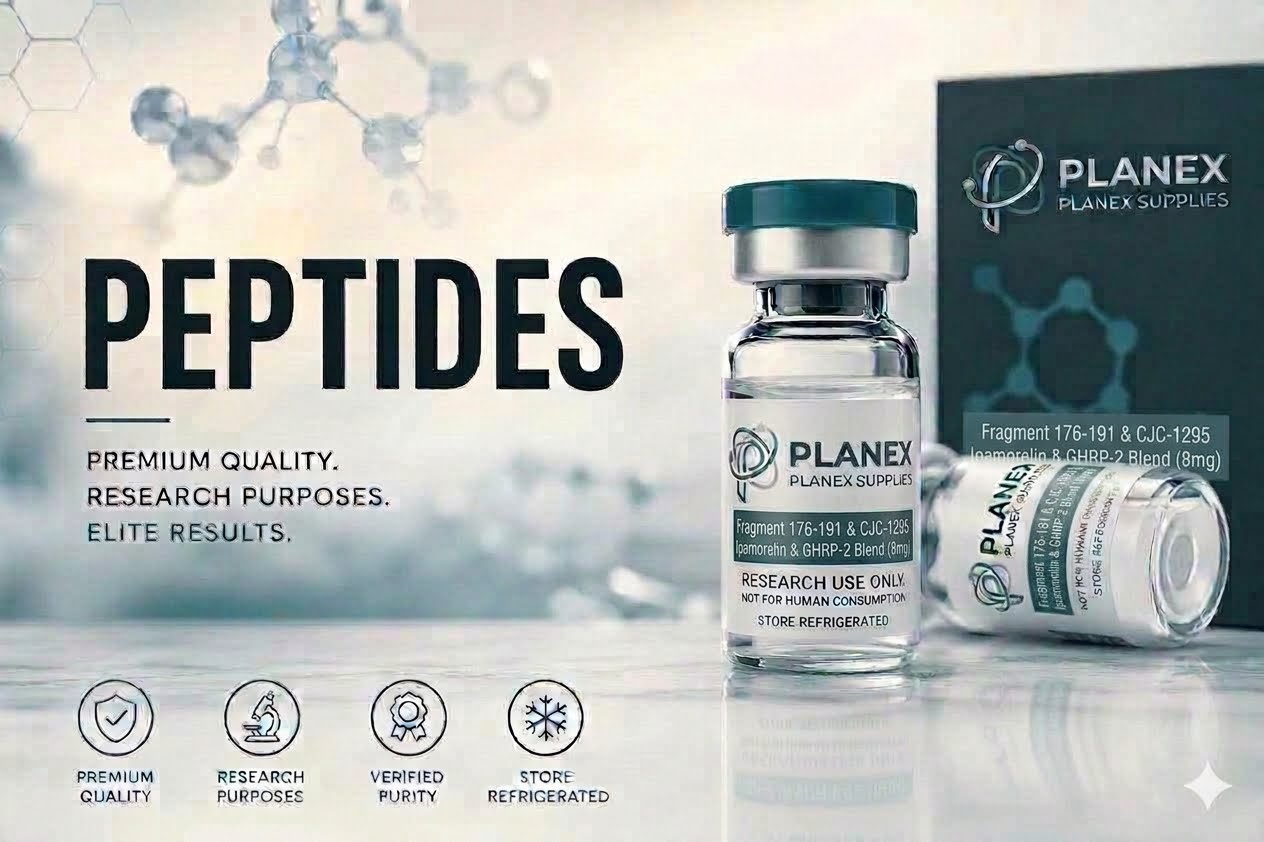
Fragment 176-191 & Mod GRF 1-29 & Ipamorelin Blend (12mg)

$87.00
Buy the high-purity Fragment 176-191, Mod GRF 1-29 & Ipamorelin Peptide Blend from Planex Supplies. This advanced composite formulation combines a targeted lipolytic hGH fragment with a potent GHRH analog and a highly selective growth hormone secretagogue (GHS). Engineered for advanced preclinical evaluation, this matrix is optimized to study growth axis pulsatility, lipid-mobilizing cascades, and skeletal tissue homeostasis. Every batch is independently USA-tested with transparent, documented Certificates of Analysis (COAs) to guarantee standard-setting laboratory integrity.
Advanced Triple-Action Endocrine & Lipolytic Research Blend
The Fragment 176-191 & Mod GRF 1-29 & Ipamorelin Peptide Blend from Planex Supplies represents a highly coordinated multi-component system designed for advanced preclinical experimentation. By combining a selective growth hormone fragment with two complementary secretagogues, this composite formulation allows investigators to study accelerated fat mobilization and dual-pathway growth axis activation without competing for the same receptor sites in mammalian models.
Comprehensive Technical Specifications:
Fragment 176-191 (AOD-9604 / Lipolytic Fragment)
- Molecular Formula: C₇₈H₁₂₅N₂₃O₂₃S₂
- Molecular Weight: 1817.1 g/mol
- Sequence: Tyr-Leu-Arg-Ile-Val-Gln-Cys-Arg-Ser-Val-Glu-Gly-Ser-Cys-Gly-Phe
Mod GRF 1-29 (Modified GRF 1-29 / GHRH Analog)
- Molecular Formula: C₁₅ Burner₂₅₂N₄₄O₄₂
- Molecular Weight: 3367.95 g/mol
- Sequence: H-Tyr-D-Ala-Asp-Ala-Ile-Phe-Thr-Gln-Ser-Tyr-Arg-Lys-Val-Leu-Ala-Gln-Leu-Ser-Ala-Arg-Lys-Leu-Leu-Gln-Asp-Ile-Leu-Ser-Arg-NH₂
Ipamorelin (Selective Ghrelin Receptor Agonist)
- Molecular Formula: C₃₈H₄₉N₉O₅
- Molecular Weight: 711.86 g/mol
- Sequence: Aib-His-D-2Nal-D-Phe-Lys-NH₂
Key Areas of Scientific Research & Mechanisms:
- Targeted Lipolysis & Beta-3 Adrenergic Signaling: Fragment 176-191 isolates the specific C-terminal portion of the hGH molecule responsible for fat restriction and breakdown. Research suggests it selectively targets beta-3 adrenergic receptors (ADRB3) to amplify lipolysis and suppress lipogenesis within adipose tissues. Literature notes that it acts downstream to upregulate critical metabolic enzymes and trigger skeletal muscle thermogenesis without introducing unwanted full-molecule growth factors like altered insulin sensitivity or long-bone growth.
- Growth Axis Pulsatility & Biomarkers: Combining Mod GRF 1-29 (a stabilized GHRH analog) with Ipamorelin (a ghrelin mimetic targeting GHS-R1a) simulates a massive, coordinated amplification of growth hormone output. Preclinical evaluations suggest that structurally optimized Mod GRF analogs can drive a 70% to 107% elevation in 12-hour GH secretion alongside a 28% increase in system-wide Insulin-Like Growth Factor 1 (IGF-1) markers, while selective Ipamorelin signaling can provoke an isolated spike up to 60 times above baseline.
- Anabolic Muscle Preservation & Nitrogen Balance: Mod GRF 1-29 is heavily studied in body composition models for its dual action on muscle fiber growth via hypertrophy (fiber size) and hyperplasia (fiber count). Concurrently, Ipamorelin is evaluated for its anti-catabolic properties. In induced catabolic states, research indicates Ipamorelin exposure can lead to a 20% reduction in liver urea-N production (CUNS) and downregulate urea cycle enzymes, successfully re-establishing positive nitrogen balance profiles.
- Chondrocyte & Skeletal Matrix Remodeling: Beyond endocrine pathways, this blend provides a versatile platform for studying degenerative structural conditions like osteoarthritis. In cartilage regeneration models, Fragment 176-191 has demonstrated an ability to act synergistically with hyaluronic acid to potentiate chondrocyte growth and joint cartilage repair. In parallel, real-time DXA and mid-diaphyseal pQCT scans indicate Ipamorelin acts directly on osteoblasts to expand total bone cross-sectional area and vertebral bone mineral content (BMC).
The Planex Supplies Quality Standard
At Planex Supplies, we prioritize rigorous quality control protocols to protect the accuracy and reproducibility of your laboratory findings. Our Fragment + Mod GRF + Ipamorelin matrix is synthesized to maximum purity and validated using high-performance liquid chromatography (HPLC). Every single batch is backed by a fully documented, third-party Certificate of Analysis (COA) issued by an independent laboratory in the USA.
- Verified Purity: ≥ 99% purity guaranteed through mass spectrometry and HPLC profiling.
- USA Vetted: Independently verified to ensure structural identity, correct molecular mass, and zero cross-contaminants.
- Research Use Only: This compound is synthesized exclusively for in vitro laboratory experimentation and preclinical evaluation. Make sure to double-check the physical label to confirm this information.
Be the first to review “Fragment 176-191 & Mod GRF 1-29 & Ipamorelin Blend (12mg)”
Related products
Peptide Blends
$81.00
Peptide Blends
$87.00
$109.00

Peptide Blends
$84.00

Peptides
$161.00

Peptide Blends
$86.00
Peptide Blends
$305.00

$210.00
Reviews
There are no reviews yet.