
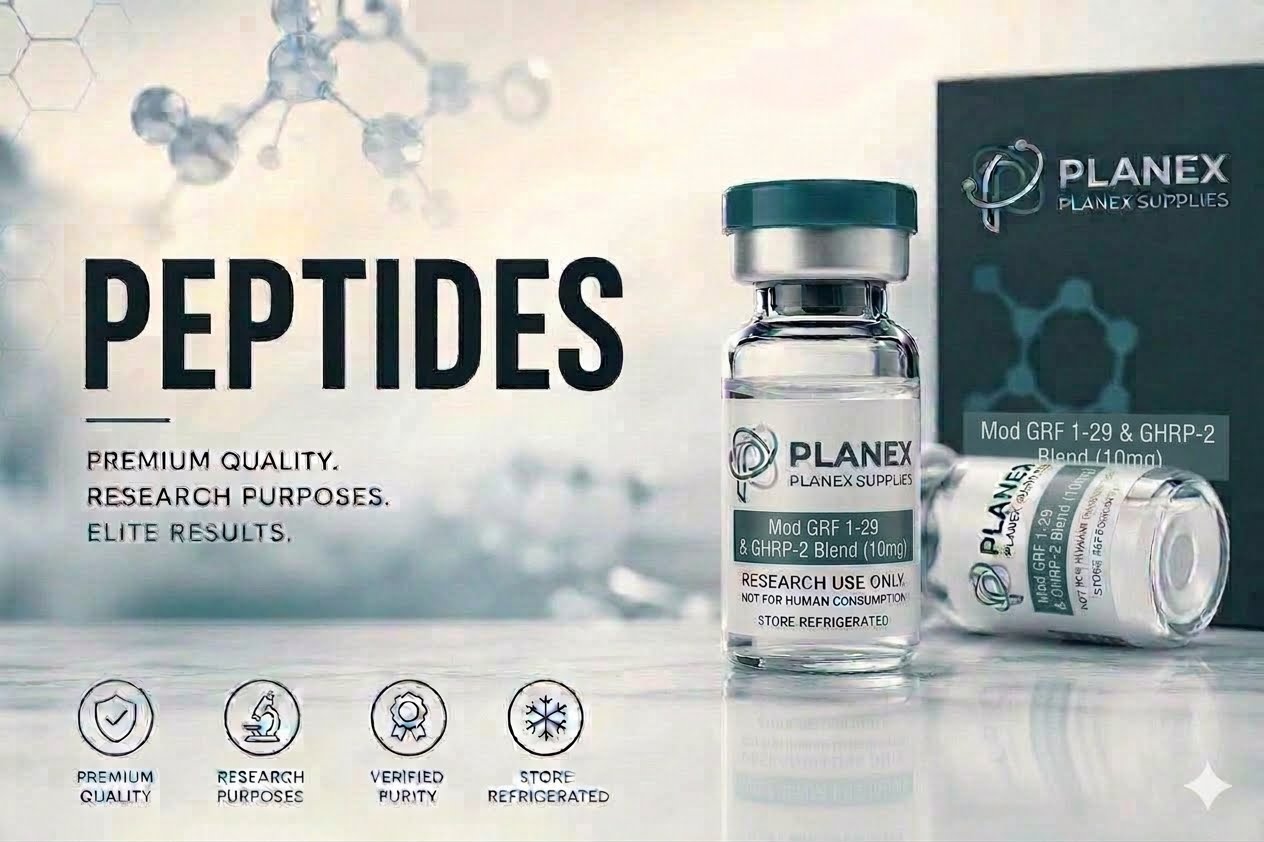
Buy Mod GRF 1-29 & GHRP-2 Blend (10mg)

$84.00
Buy the premium Modified GRF 1-29 & GHRP-2 Peptide Blend from Planex Supplies. This advanced dual-action research formulation combines a highly stable, tetra-substituted GHRH analog with a potent second-generation growth hormone secretagogue (GHS). Together, they are engineered to evaluate synergistic neuroendocrine kinetics, downstream IGF-1 cellular cascades, and pancreatic islet survival mechanisms. Every batch is independently USA-tested with transparent, documented Certificates of Analysis (COAs) to guarantee standard-setting laboratory integrity.
Advanced Coordinated Pituitary Receptor Axis Research
The Modified GRF 1-29 & GHRP-2 Peptide Blend from Planex Supplies links two distinct molecular structures engineered to study parallel growth hormone (GH) secretagogue pathways without receptor cross-competition. By simultaneously pairing a stabilized Growth Hormone-Releasing Hormone (GHRH) receptor agonist with a selective ghrelin receptor (GHS-R1a) mimetic, this composite formulation provides a robust preclinical framework for investigating amplified somatic cell activity, tissue repair signaling, and metabolic homeostasis in mammalian models.
Comprehensive Technical Specifications:
Modified GRF 1-29 (Mod GRF 1-29 / GHRH Analog)
-
- Molecular Formula: C₁₅₂H₂₅₂N₄₄O₄₂
- Molecular Weight: 3367.95 g/mol
- Sequence: H-Tyr-D-Ala-Asp-Ala-Ile-Phe-Thr-Gln-Ser-Tyr-Arg-Lys-Val-Leu-Ala-Gln-Leu-Ser-Ala-Arg-Lys-Leu-Leu-Gln-Asp-Ile-Leu-Ser-Arg-NH₂
GHRP-2 (Growth Hormone Releasing Peptide 2 / GHS)
-
- Molecular Formula: C₄₅H₅₅N₉O₆
- Molecular Weight: 817.97 g/mol
- Sequence: H-D-Ala-D-2-Nal-Ala-Trp-D-Phe-Lys-NH₂
Key Areas of Scientific Research & Complementary Mechanisms:
-
- Enzymatic Resistance & cAMP Pathways: Modified GRF 1-29 features four precise amino acid substitutions (at the 2nd, 8th, 15th, and 27th positions) designed to resist enzymatic breakdown by dipeptidyl peptidase-4 (DPP-4) and prevent methionine oxidation. Upon binding to pituitary GHRH receptors, it upregulates the adenylyl cyclase pathway, converting ATP to cAMP. This activates protein kinase A (PKA) to open voltage-dependent calcium channels, driving calcium influx and prompting pulsatile growth hormone discharge.
- Phospholipase C Co-Activation & Synergy: GHRP-2 acts downstream via a separate, highly responsive pathway by binding to hypothalamic and pituitary ghrelin receptors (GHS-R1a). This conformational change triggers the phospholipase C (PLC) cascade, splitting cellular substrates into IP3 and DAG. IP3 mobilizes calcium from intracellular stores, compounding the calcium signals initiated by Mod GRF 1-29. This dual-pathway mechanism is heavily researched for its capacity to bypass Somatostatin feedback limits and maximize cellular secretion peaks.
- Pancreatic Islet Survival & Glycemic Regulation: GHRH analogs are actively investigated for their protective role in metabolic models. Preclinical data indicates that short-term exposure can upregulate localized Insulin-Like Growth Factors, improving the cellular proliferation and survival rates of pancreatic islets under diabetic stress. Research models also point to a significant expansion of islet size, increased insulin expression, and a reduction in circulating triglyceride-rich lipoproteins.
- Cardioprotection & Extracellular Matrix Repair: In ischemic and reperfusion models, GHRH agonists have demonstrated notable therapeutic potential. Studies reveal that exposure can optimize end-diastolic pressure, improve stroke work, and limit localized tissue scarring following myocardial injury. This cytoprotection is closely linked to downstream growth hormone cascades that downregulate oxidative stress, promote fibroblast proliferation, and accelerate collagen synthesis required for vascular and skeletal bone mineral density maintenance.
The Planex Supplies Quality Standard
At Planex Supplies, we execute strict quality control metrics to ensure the absolute precision and chemical consistency of your laboratory materials. Our Modified GRF 1-29 + GHRP-2 blend is synthesized to high structural tolerances and verified using high-performance liquid chromatography (HPLC). Every batch is paired with a fully documented, third-party Certificate of Analysis (COA) conducted entirely within the United States.
- Verified Purity: ≥ 99% purity guaranteed through mass spectrometry and HPLC profiling.
- USA Vetted: Independent laboratory testing ensures correct molecular weight fractions and zero chemical cross-contaminants.
- Research Use Only: This compound is synthesized exclusively for in vitro laboratory experimentation and preclinical evaluation. Make sure to double-check the physical label to confirm this information.
Be the first to review “Buy Mod GRF 1-29 & GHRP-2 Blend (10mg)”
Related products

Peptide Blends
$305.00
Peptide Blends
$90.00

Peptides
$56.00
Peptide Blends
$86.00

$210.00

Peptide Blends
$80.00
Peptide Blends
$115.00

$80.00
Reviews
There are no reviews yet.