
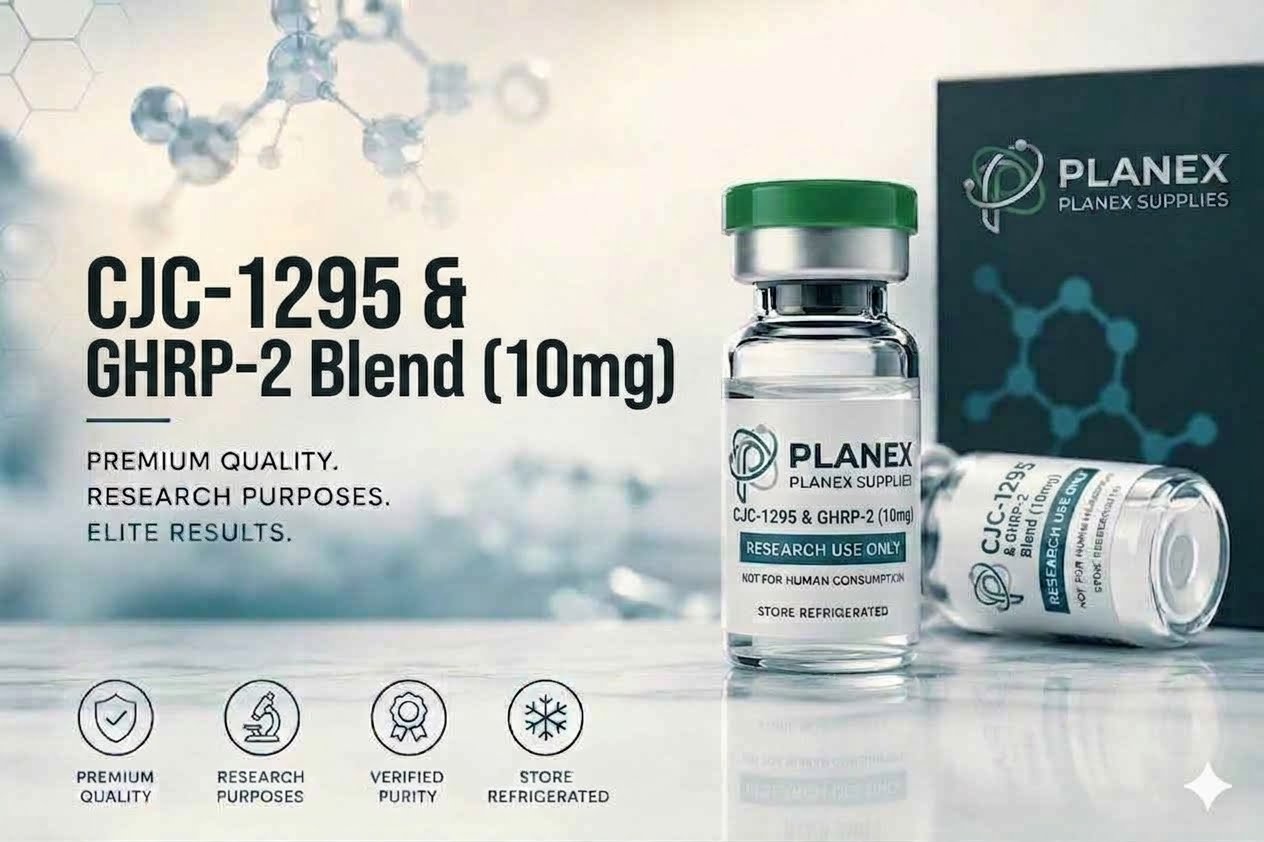
Buy CJC-1295 & GHRP-2 Blend (10mg)
$84.00
Buy the premium CJC-1295 & GHRP-2 Peptide Blend from Planex Supplies. This advanced dual-action research formulation combines a selective Growth Hormone-Releasing Hormone (GHRH) receptor agonist with a powerful Growth Hormone Secretagogue (GHRP). Together, they are engineered to evaluate synergistic neuroendocrine axis kinetics, downstream IGF-1 signaling cascades, and metabolic cellular mechanisms. Every batch is independently USA-tested with transparent, documented Certificates of Analysis (COAs) to guarantee standard-setting laboratory integrity.
Advanced Dual-Action Neuroendocrine Research Formulation
The CJC-1295 & GHRP-2 Peptide Blend from Planex Supplies bridges two distinct chemical structures engineered to target separate receptors within the mammalian central nervous system and pituitary gland. By simultaneously stimulating Growth Hormone-Releasing Hormone (GHRH) pathways and Ghrelin/Growth Hormone Secretagogue receptors (GHS-R1a), this composite formulation allows investigators to study potent, cumulative cellular responses and complex molecular synergies in preclinical laboratory models.
Comprehensive Technical Specifications:
CJC-1295 (Modified GRF 1-29 / Tetra-Substituted GHRH Fragment) (Note: Formulated without DAC for precise pulsatile simulation)
- Molecular Formula: C₁₅₂H₂₂₂N₄₄O₄₂
- Molecular Weight: 3367.9 g/mol
- Sequence: H-Tyr-D-Ala-Asp-Ala-Ile-Phe-Thr-Gln-Ser-Tyr-Arg-Lys-Val-Leu-Ala-Gln-Leu-Ser-Ala-Arg-Lys-Leu-Leu-Gln-Asp-Ile-Leu-Ser-Arg-Lys(Mal)-NH2
- PubChem Identifier: CID 56841945
GHRP-2 (Growth Hormone Releasing Peptide 2 / Synthetic Hexapeptide)
- Molecular Formula: C₄₅H₅₅N₉O₆
- Molecular Weight: 817.9749 g/mol
- Sequence: D-Ala-D-2Nal-Ala-Trp-D-Phe-Lys
Key Areas of Scientific Research & Complementary Mechanisms:
- Pituitary G-Protein Signal Transduction: CJC-1295 binds directly to GHRH receptors on somatotroph cells, mimicking native GHRH but with vastly improved pharmacokinetic properties, demonstrating presence in plasma beyond 72 hours under study conditions. This binding triggers conformational changes that activate intracellular G-proteins, generating secondary messengers (cAMP and IP3). Literature notes that this cascade can stimulate a 4-fold higher growth hormone secretion area-under-the-curve compared to standard GRF 1–29, elevating basal GH levels up to 7.5-fold.
- Downstream Anabolic IGF-1 Production: By driving elevated baseline growth hormone levels, CJC-1295 acts as a precursor to systemic Insulin-like Growth Factor-1 (IGF-1) upregulation. As GH binds to liver cell receptors, it initiates the Janus kinase-signal transducer and activator of transcription (JAK-STAT) signaling pathway. The activated STAT proteins translocate to the cell nucleus to transcribe the IGF-1 gene, prompting anabolic cellular growth, protein synthesis, and tissue proliferation models.
- Receptor Co-Activation & Secretagogue Synergism: GHRP-2 is a synthetic hexapeptide that binds via non-covalent interactions to ghrelin/GHS-R1a receptors in the hypothalamus and pituitary. This triggers a parallel G\(\alpha _{q/11}\) subunit cascade, utilizing Phospholipase C (PLC) to amplify intracellular calcium release and protein kinase C (PKC) activation. While GHRH-mimetics alone show a 20-fold increase in pulsatile secretion, combining them with GHRP-2 has been observed to cause a 54-fold increase in pulsatile GH secretion while reducing time-to-maximal secretion by a median of 43%.
- Hypothalamic Appetite Regulation and Energy Homeostasis: Because GHRP-2 behaves as a ghrelin analogue, it is heavily utilized to evaluate the neurobiology of appetite stimulation and metabolic weight adaptations. By binding to GHSR-1a receptors located in the stomach, pituitary, and hypothalamus, it provides a stable framework for investigating ghrelin-associated eating behaviors, food consumption trends, and total systemic energy distribution changes.
The Planex Supplies Quality Standard
At Planex Supplies, we prioritize rigorous quality control protocols to protect the validity of your laboratory data. Our CJC-1295 + GHRP-2 blend is synthesized to maximum purity and verified through high-performance liquid chromatography (HPLC). We back every batch with fully documented, third-party Certificates of Analysis (COAs) conducted right here in the USA.
- Verified Purity: ≥ 99% purity guaranteed through mass spectrometry and HPLC profiling.
- USA Vetted: Independent laboratory confirmation ensures absolute consistency, proper amino acid sequence replication, and complete freedom from residual chemical cross-contaminants.
- Research Use Only: This compound is synthesized exclusively for in vitro laboratory experimentation and preclinical evaluation. Make sure to double-check the physical label to confirm this information.
Be the first to review “Buy CJC-1295 & GHRP-2 Blend (10mg)”
Related products
Peptide Blends
$88.00

Peptides
$88.00

Peptides
$77.00
Peptide Blends
$90.00
Peptide Blends
$305.00
Peptide Blends
$84.00
$109.00

Peptide Blends
$84.00
Reviews
There are no reviews yet.