
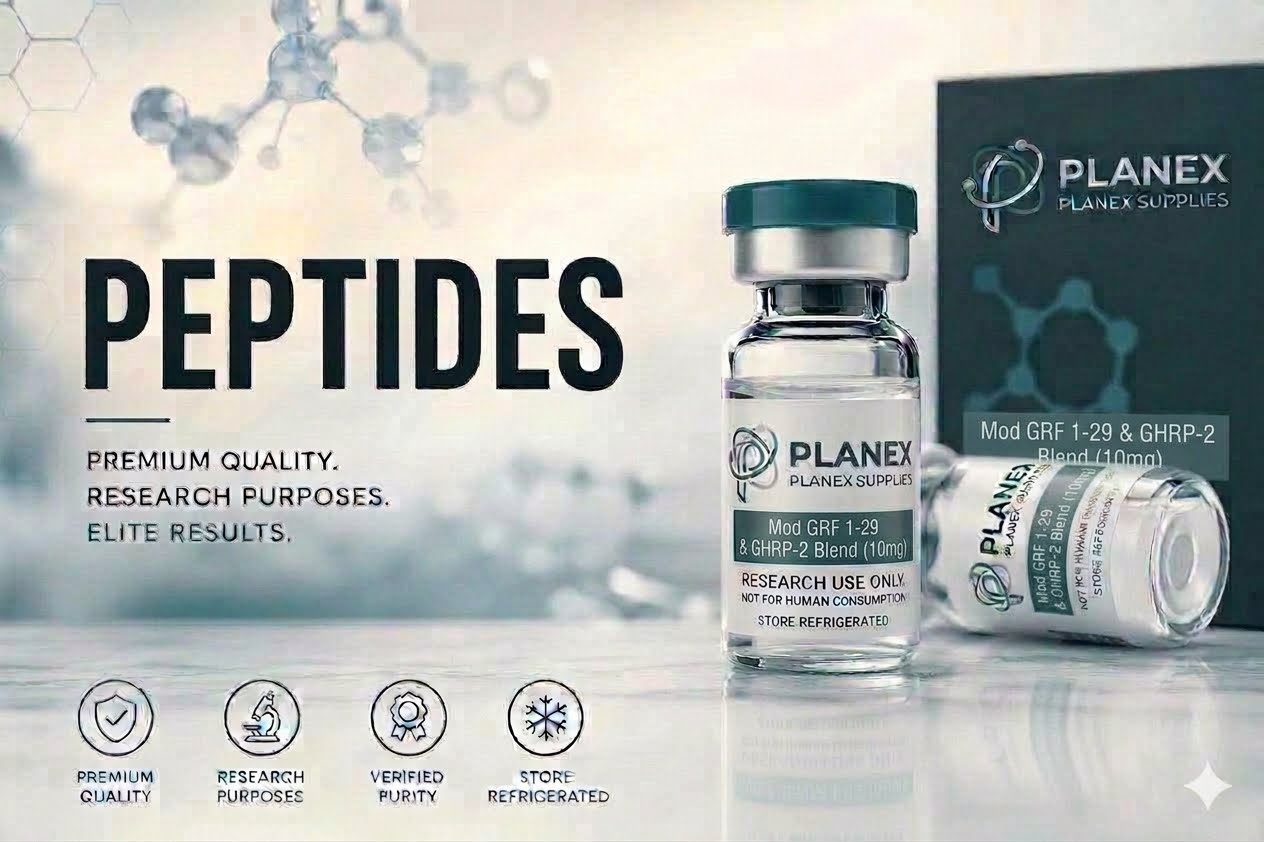
Buy Mod GRF 1-29 & GHRP-6 (10mg)

$86.00
Buy the premium Mod GRF (1-29) & GHRP-6 Peptide Blend from Planex Supplies. This advanced dual-action research formulation combines a highly stable, short-chain GHRH analog with a synthetic growth hormone secretagogue (GHS). Together, they are engineered to evaluate dual-pathway pituitary receptor co-activation, localized neuroprotective survival mechanisms, and CD36 scavenger receptor kinetics. Every batch is independently USA-tested with transparent, documented Certificates of Analysis (COAs) to guarantee standard-setting laboratory integrity.
Advanced Dual-Action Pituitary Axis & Neurovascular Research Blend
The Mod GRF (1-29) & GHRP-6 Peptide Blend from Planex Supplies brings together two distinct molecular architectures studied for their parallel, non-competitive interactions within the growth hormone (GH) axis. By pairing Mod GRF (1-29)—a structurally enhanced Growth Hormone-Releasing Hormone (GHRH) analog—with GHRP-6, a specialized ghrelin receptor agonist, this blend allows investigators to evaluate complex secondary messenger cascades, downstream Insulin-Like Growth Factor 1 (IGF-1) responses, and structural cellular protection within the central nervous system.
Comprehensive Technical Specifications:
Modified Growth Hormone Releasing Factor (Mod GRF 1-29 / GHRH Analog)
-
- Molecular Formula: C₁₅₂H₂₅₂N₄₄O₄₂
- Molecular Weight: 3367.95 g/mol
- Sequence: H-Tyr-D-Ala-Asp-Ala-Ile-Phe-Thr-Gln-Ser-Tyr-Arg-Lys-Val-Leu-Ala-Gln-Leu-Ser-Ala-Arg-Lys-Leu-Leu-Gln-Asp-Ile-Leu-Ser-Arg-NH₂
GHRP-6 (Growth Hormone Releasing Peptide-6 / GHS)
-
- Molecular Formula: C₄₆H₅₆N₁₂O₆
- Molecular Weight: 873.032 g/mol
- Sequence: L-histidyl-D-tryptophyl-L-alanyl-L-tryptophyl-D-phenylalanyl-L-lysergamide, triacetate
Key Areas of Scientific Research & Complementary Mechanisms:
-
- Pituitary Adenylyl Cyclase Pathway Integration: Mod GRF (1-29) targets GHRH receptors located on anterior pituitary somatotroph cells. Structural engineering preserves full biological activity while dramatically extending the fragment’s durability against enzymatic degradation. Receptor binding triggers an adenylyl cyclase cascade that converts ATP to cyclic AMP (cAMP). This activates protein kinase A (PKA) to phosphorylate voltage-dependent calcium channels, stimulating secretory vesicles and upregulating baseline growth hormone output by an estimated 70% to 107% over 12 hours.
- Phospholipase C Co-Activation & Secretagogue Synergy: Operating through a separate molecular framework, GHRP-6 functions as an analogue to the hunger hormone, ghrelin. It targets Growth Hormone Secretagogue Receptors (GHS-R1a), initiating a conformational shift that activates the phospholipase C (PLC) pathway. This generates secondary messengers IP3 and DAG, which trigger rapid calcium ion release from intracellular storage complexes like the endoplasmic reticulum. Preclinical data indicates this dual activation can stimulate up to 3 times the GH release compared to controls while driving a 28% increase in anabolic IGF-1 expression.
- Excitotoxic Mitigation & Region-Specific Neuroprotection: In neurodegenerative and ischemic stroke models, GHRP-6 is heavily researched for its capacity to reinforce cognitive performance and spatial learning. Preclinical rodent studies show a distinct reduction in cell death volumes within target cerebral populations like the caudate–putamen nuclei. Furthermore, locally induced IGF-1 expression within the hypothalamus, cerebellum, and hippocampus has been observed to mitigate glutamate-induced cell death, offering a robust model for studying survival mechanisms against excitotoxic neuronal damage.
- CD36 Scavenger Receptor Kinetics & Foam Cell Regulation: Beyond endocrine systems, competitive binding assays reveal that GHRP-6 exhibits a high affinity for CD36 scavenger receptors. Macrophages typically internalize oxidized low-density lipoproteins (ox-LDL) via CD36, driving the lipid accumulation that forms foam cells in atherosclerosis models. Because GHRP-6 shares a common binding site with ox-LDL, investigators utilize this peptide matrix to explore competitive inhibition pathways, immune cell regulations, and macrophage endocytosis.
The Planex Supplies Quality Standard
At Planex Supplies, we prioritize rigorous analytical vetting to protect the replication standards of your laboratory research. Our Mod GRF (1-29) + GHRP-6 blend is synthesized to high structural standards and characterized via high-performance liquid chromatography (HPLC). Every batch is verified by independent, third-party laboratories in the United States and backed by documented Certificates of Analysis (COAs).
- Verified Purity: ≥ 99% purity guaranteed through mass spectrometry and HPLC profiling.
- USA Vetted: Independent laboratory testing ensures structural sequence identity, accurate molecular mass, and freedom from cross-contaminants.
- Research Use Only: This compound is synthesized exclusively for in vitro laboratory experimentation and preclinical evaluation. Make sure to double-check the physical label to confirm this information.
Be the first to review “Buy Mod GRF 1-29 & GHRP-6 (10mg)”
Related products

Peptide Blends
$84.00
Peptide Blends
$115.00

$210.00
Peptide Blends
$90.00
Peptide Blends
$81.00

Peptide Blends
$81.00

Peptides
$86.00
Peptide Blends
$80.00
Reviews
There are no reviews yet.