Advanced Uncoordinated Tripeptide Fragment for Metal-Affinity Vetting
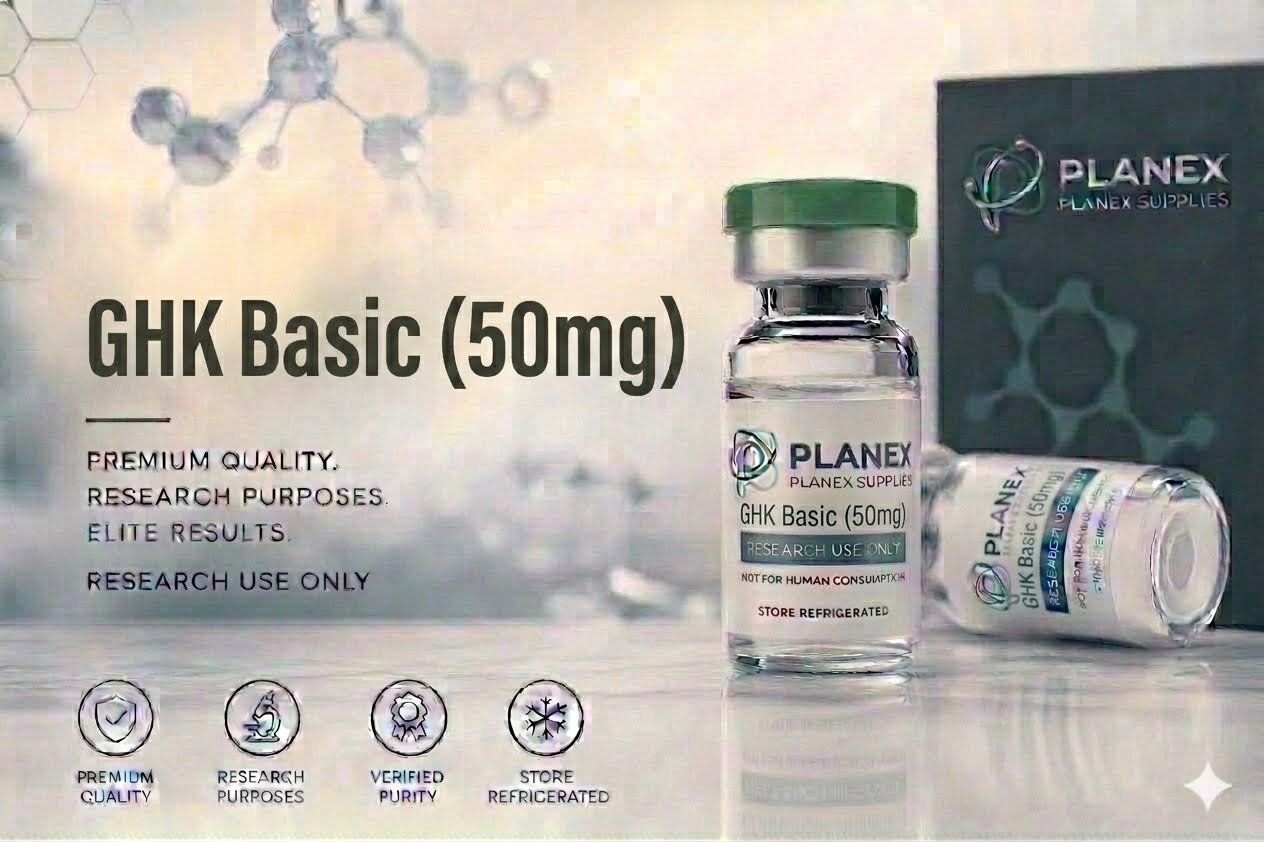
GHK Basic (chemically recognized as Glycylhistidyllysine) is a naturally occurring low-molecular-weight tripeptide configured for advanced research into cell injury responses, tissue regeneration kinetics, and extracellular matrix (ECM) structural maintenance. While frequently studied in its copper-coordinated form (GHK-Cu), GHK Basic represents the pure, uncomplexed peptide backbone. It serves as an exceptional laboratory model for evaluating native peptide-metal interactions, spontaneous chelation kinetics, and downstream gene transcription shifts when exposed to transition elements within cellular microenvironments.
Comprehensive Technical Specifications:
- Amino Acid Sequence: Gly-His-Lys (GHK Basic)
- Molecular Formula: C₁₄H₂₄N₆O₄
- Molecular Weight: 340.4 g/mol
- Synonyms: Glycylhistidyllysine, GHK Free Base, Uncomplexed Copper Peptide Backbone
Key Areas of Scientific Research & Mechanistic Profiles:
- Copper-Binding Affinity and Chelation Dynamics: GHK Basic possesses an extraordinarily strong physical affinity for copper (II) ions. In native physiology, this short peptide fragment is released from local tissue matrices immediately following injury or cellular stress. Researchers utilize the uncoordinated GHK Basic framework to map out spontaneous chelation mechanics, tracking how the molecule captures free Cu (II) to form active metallopeptide complexes. This allows for precise observation of electron transfer reactions and transitions between oxidized Cu (II) and reduced Cu (I) states.
- Collagen/SPARC Homology and Extracellular Matrix Repair: The specific amino acid sequence of GHK Basic is inherently encoded within the structural architecture of full-length collagen molecules and the SPARC (Secreted Protein Acidic and Rich in Cysteine) glycoprotein matrix. Preclinical models indicate that introducing the free tripeptide signals fibroblasts to accelerate the endogenous production of structural proteins, including type-1 collagen, elastin, and glycosaminoglycans. This upregulates the overall structural integrity, moisture-binding properties, and elasticity baselines of tissue models.
- Biochemical Cofactor Kinetics and Enzyme Activation: Once chelated with copper inside laboratory models, the resulting complex acts as a vital cofactor for a vast matrix of essential enzymes. Investigators employ GHK Basic to study the activation pathways of copper-dependent enzymes that dictate cellular respiration, iron metabolism, and blood-clotting cascades. It serves as a prime candidate for evaluating superoxide dismutase (SOD) profiling, which neutralizes destructive free radicals to protect delicate cell walls from oxidative damage.
- Multi-Channel Angiogenesis and Neurovascular Growth: Preclinical research leverages GHK Basic to explore gene expression pathways that control stress and injury remediation. The peptide is monitored for its capacity to stimulate vascular endothelial cells, upregulating local growth factors to drive angiogenesis (new blood vessel expansion) and promote active nerve outgrowth. These integrated neurovascular traits are widely examined in preclinical models to explore follicle growth stimulation, tissue repair acceleration, and the potential reversal of age-related systemic regenerative declines.
The Planex Supplies Quality Standard
At Planex Supplies, we enforce rigid quality control protocols to protect the baseline accuracy and replication standards of your preclinical research. Our GHK Basic peptide is synthesized to high structural tolerances and verified via high-performance liquid chromatography (HPLC). Every single batch is independently vetted within the United States and backed by accessible, documented Certificates of Analysis (COAs) to guarantee strict molecular purity.
- Verified Purity: ≥ 99% purity guaranteed through mass spectrometry and HPLC profiling.
- USA Vetted: Independent laboratory confirmation ensures absolute consistency, exact sequence verification, and complete freedom from residual chemical cross-contaminants or unlisted additives.
- Research Use Only: This compound is synthesized exclusively for in vitro laboratory experimentation and preclinical evaluation. Make sure to double-check the physical label to confirm this information.
Be the first to review “Buy GHK Basic (50mg)”
Related products

Peptide Blends
$81.00

Peptides
$115.00

Peptides
$88.00

Peptide Blends
$80.00

Peptides
$62.00
Peptide Blends
$87.00
Peptide Blends
$115.00
Peptide Blends
$87.00
Reviews
There are no reviews yet.