
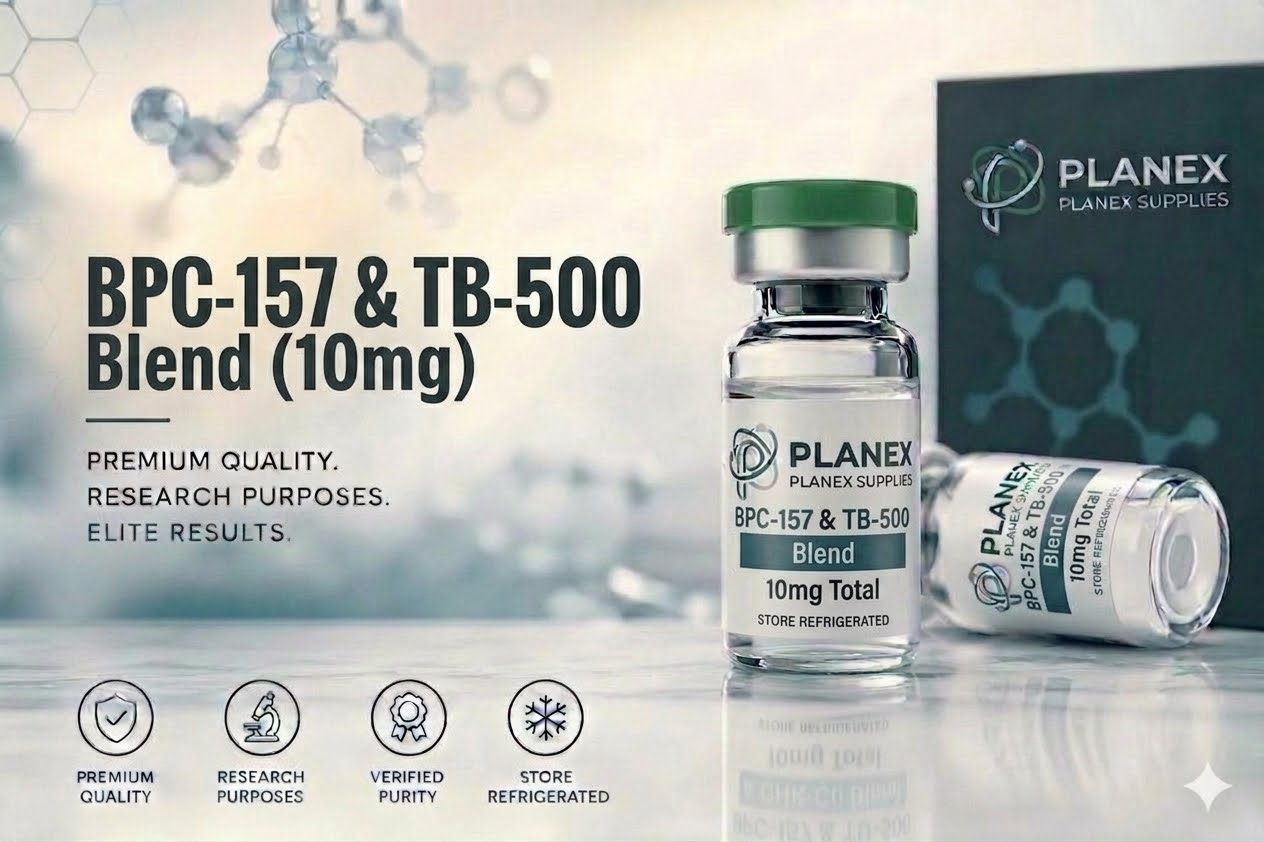
Buy BPC-157 & TB-500 Blend (10mg)
$115.00
Buy the premium BPC-157 & TB-500 Peptide Blend from Planex Supplies. This advanced dual-action research formulation combines a gastric-derived cytoprotective pentadecapeptide with a synthetic cytoskeletal actin-binding protein fragment. Engineered for advanced preclinical research, this blend is optimized to study dual-pathway tissue remodeling, axin-mediated fibroblast migration, and accelerated vascular endothelial growth. Every batch is independently USA-tested with transparent, documented Certificates of Analysis (COAs) to guarantee standard-setting laboratory integrity.
Advanced Dual-Action Framework for Cellular Migration and Healing Research
The BPC-157 & TB-500 Peptide Blend from Planex Supplies brings together two distinct molecular architectures widely studied for their overlapping, non-competitive activity within tissue repair systems. While both compounds are examined for their relevance to structural tissue healing, preclinical findings indicate they leverage complementary biochemical pathways. Researchers frequently evaluate this combined formulation to study potential synergistic molecular actions that may enhance tissue flexibility, cellular motility, and structural repair processes in mammalian models following induced cellular damage.
Comprehensive Technical Specifications:
BPC-157 (Body Protection Compound-157)
-
- Molecular Formula: C₆₂H₉₈N₁₆O₂₂
- Molecular Weight: 1419.55 g/mol
- Sequence: L-Valine,glycyl-L-alpha-glutamyl-L-prolyl-L-prolyl-Lprolylglycyl-L-lysyl-L-prolyl-L-alanyl-L-alpha-aspartyl-L-alpha-aspartyl-L-alanylglycyl-L-leucyl-;glycyl-L-alpha-glutamyl-L-prolyl-L-prolyl-L-prolylglycyllysyl-L-prolyl-L-alanyl-L- alpha-aspartylL-alpha-aspartyl-L-alanylglycyl-L-leucyl-L-valine
TB-500 (Thymosin Beta-4 Fragment)
-
- Molecular Formula: C₂₁₂H₃₅₀N₅₆O₇₈S
- Molecular Weight: 4963 g/mol
- Sequence: Ac-Ser-Asp-Lys-Pro-Asp-Met-Ala-Glu-lle-GluLys-Phe-Asp-Lys-Ser-Lys-Leu-Lys-LysThr-Glu-Thr-Gin-Glu-Lys-Asn-Pro-Leu-Pro-Ser-Lys-GluThy-lleGlu-Gin-Glu-Lys-Gin-Ala-Gly-Glu-Ser
Key Areas of Scientific Research & Complementary Mechanisms:
-
- Axin Regulation and Accelerated Cellular Migration: Successful tissue repair relies on the precise recruitment and execution of fibroblasts and immune cells to the site of cellular stress, where fibroblasts promote extracellular matrix formation. The baseline movement of these cells is highly dependent on the scaffold protein axin. Preclinical research suggests that the BPC-157 & TB-500 blend synergizes at the gene and structural level to maximize cell motility. BPC-157 promotes the transcription of the axin gene to increase protein expression and upregulate internal actin production. Concurrently, TB-500 acts as an actin-binding protein, sequestering actin in localized areas where cell movement is required, optimizing the formation of vital axin filaments.
- Soft-Tissue Remodeling and Skeletal Regeneration: Beyond cellular motility, both peptides are heavily scrutinized for structural muscle, tendon, and ligament regeneration. Studies indicate that elevated levels of TB-500 exhibit a direct stimulatory action on myoblasts and myocytes. This action is associated with reduced inflammation at injury sites, allowing researchers to observe accelerated skeletal muscle regeneration following trauma.
- Pro-Angiogenic Activation and Ischemic Repair: TB-500 is extensively advanced in preclinical cardiovascular models for its proposed involvement in cardiac muscle repair. In models simulating myocardial infarction, the peptide has been observed to reverse tissue damage by activating an endogenous response that triggers new blood vessel growth and restores perfusion to injured myocardium.
- Cystic Fibrosis and Sputum Cohesivity Kinetics: Outside traditional structural repair, the unique fluid-modulating traits of the Thymosin Beta-4 fragment make it an active candidate in respiratory research. Preclinical evaluation suggests that exposure to TB-500 alters rheological profiles, causing a distinct decrease in sputum cohesivity, which provides researchers with a stable framework for investigating cellular mechanics in cystic fibrosis models.
The Planex Supplies Quality Standard
At Planex Supplies, we prioritize rigid analytical metrics to safeguard the replication standards of your laboratory findings. Our BPC-157 & TB-500 blend is synthesized to high structural specifications and thoroughly characterized via high-performance liquid chromatography (HPLC). Every single batch is independently verified within the United States and backed by accessible, documented Certificates of Analysis (COAs) to ensure strict molecular concentration.
-
- Verified Purity: ≥ 99% purity guaranteed through mass spectrometry and HPLC profiling.
- USA Vetted: Independent laboratory confirmation ensures absolute consistency, correct peptide ratios, and complete freedom from residual chemical cross-contaminants.
- Research Use Only: This compound is synthesized exclusively for in vitro laboratory experimentation and preclinical evaluation. Make sure to double-check the physical label to confirm this information.
Be the first to review “Buy BPC-157 & TB-500 Blend (10mg)”
Related products

$80.00

Peptide Blends
$84.00

Peptides
$192.00

Peptides
$56.00

Peptide Blends
$81.00
Peptide Blends
$86.00

Peptide Blends
$84.00
Peptide Blends
$81.00
Reviews
There are no reviews yet.