
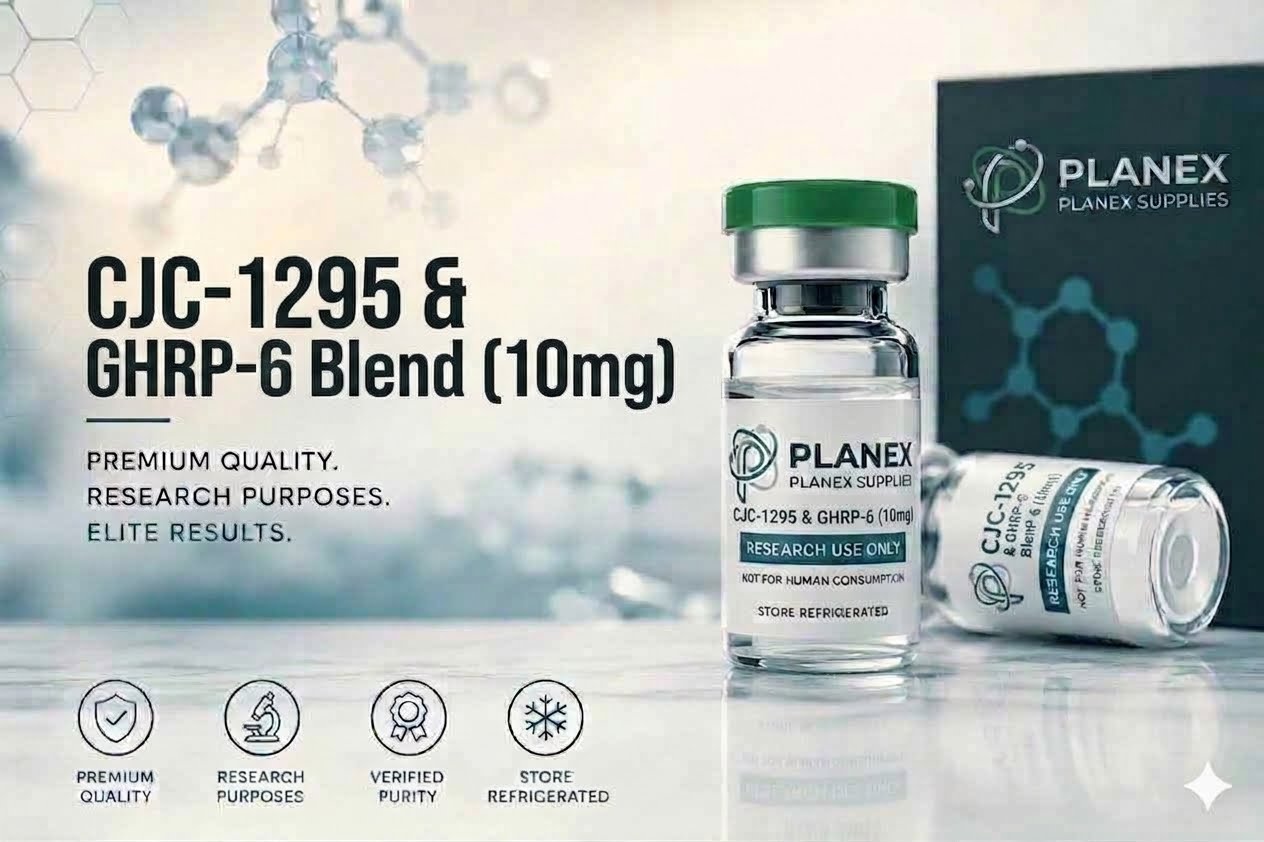
Buy CJC-1295 & GHRP-6 Blend (10mg)

$86.00
Buy the premium CJC-1295 & GHRP-6 Peptide Blend from Planex Supplies. This advanced dual-action research formulation pairs a stabilized GHRH analog with a synthetic growth hormone secretagogue (GHRP). Together, they are engineered to evaluate dual-pathway pituitary receptor co-activation, downstream Insulin-Like Growth Factor 1 (IGF-1) responses, and somatotroph cell kinetics. Every batch is independently USA-tested with transparent, documented Certificates of Analysis (COAs) to guarantee standard-setting laboratory integrity.
Synergistic Dual-Pathway Growth Hormone Secretagogue Research
The CJC-1295 & GHRP-6 Peptide Blend from Planex Supplies brings together two distinct molecular structures widely studied for their synergistic impact on the central nervous system, specifically within the pituitary gland and hypothalamus. While CJC-1295 targets the Growth Hormone-Releasing Hormone (GHRH) receptor pathway, GHRP-6 acts on the growth hormone secretagogue receptor (GHS-R1a) via ghrelin molecular mimicry. Together, they provide a powerful framework for researching concurrent pulsatile and baseline neuroendocrine signaling in preclinical laboratory models.
Comprehensive Technical Specifications:
CJC-1295 (Modified GRF 1-29 / Tetra-Substituted GHRH Fragment) (Note: Formulated without DAC for precise pulsatile simulation)
-
- Molecular Formula: C₁₅₂H₂₅₂N₄₄O₄₂
- Molecular Weight: 3367.954 g/mol
- Sequence: H-Tyr-D-Ala-Asp-Ala-Ile-Phe-Thr-Gln-Ser-Tyr-Arg-Lys-Val-Leu-Ala-Gln-Leu-Ser-Ala-Arg-Lys-Leu-Leu-Gln-Asp-Ile-Leu-Ser-Arg-Lys(Mal)-NH2
GHRP-6 (Growth Hormone Releasing Peptide 6 / Synthetic Hexapeptide)
-
- Molecular Formula: C₄₆H₅₆N₁₂O₆
- Molecular Weight: 873.032 g/mol
- Sequence: His-D-Trp-Ala-Trp-D-Phe-Lys
Key Areas of Scientific Research & Mechanistic Profiles:
-
- Enzymatic Resistance and GHRH Receptor Affinity: CJC-1295 is an engineered analog representing the functional 29-amino-acid chain of endogenous GHRH. It incorporates four precise amino acid substitutions designed to dramatically enhance resistance against dipeptidyl peptidase-4 (DPP-4) enzymatic degradation. Preclinical data indicates that CJC-1295 upregulates total pituitary RNA and GH mRNA, indicating localized somatotroph cell proliferation. It works to bind to GHRH receptors in the anterior pituitary gland, helping to maintain natural pulsatile production patterns.
- Receptor Mimicry and Systemic Biomarker Elevations: GHRP-6 functions as a synthetic secretagogue that mimics the molecular layout of the hunger hormone, ghrelin. It targets GHS-R1a receptors on pituitary cells and specialized hypothalamic neurons. Combined exposures demonstrate that GHRP-6 sustains baseline hormone levels, while CJC-1295 drives high-amplitude spikes, elevating mean GH concentrations by 2- to 10-fold under study conditions. This sustained action leads to a documented 46% increase in mean GH levels and a 45% increase in anabolic mediators such as Insulin-Like Growth Factor 1 (IGF-1).
- Neuroprotective Signaling and Excitotoxic Defense: In neurodegenerative and ischemic stroke models, GHRP-6 is heavily researched for its capacity to reinforce cognitive performance and spatial learning. Preclinical rodent studies show a distinct reduction in cell death volumes within target cerebral populations like the caudate–putamen nuclei. Furthermore, locally induced IGF-1 expression within the hypothalamus, cerebellum, and hippocampus has been observed to mitigate glutamate-induced cell death, offering a robust model for studying survival mechanisms against excitotoxic neuronal damage and shifting the cell cycle away from apoptosis.
- CD36 Scavenger Preference and Cytoprotection: Beyond neuroendocrine pathways, GHRP-6 demonstrates a unique affinity for CD36 receptors, which modulate fatty acid absorption, immune responses, and macrophage phagocytosis. Researchers explore this pathway in cardiovascular and ischemia-reperfusion models to evaluate the peptide’s ability to limit myocardial tissue scarring and regulate angiogenesis. Because GHRP-6 shares a common binding site with ox-LDL, investigators utilize this peptide matrix to explore competitive inhibition pathways and immune cell regulations.
The Planex Supplies Quality Standard
At Planex Supplies, we prioritize rigid analytical vetting to protect the replication standards of your laboratory findings. Our CJC-1295 + GHRP-6 blend is synthesized to high structural specifications and characterized via high-performance liquid chromatography (HPLC). Every batch is verified by independent, third-party laboratories in the United States and backed by documented Certificates of Analysis (COAs).
-
- Verified Purity: ≥ 99% purity guaranteed through mass spectrometry and HPLC profiling.
- USA Vetted: Independent laboratory testing ensures structural sequence identity, accurate molecular mass, and complete freedom from residual chemical cross-contaminants.
- Research Use Only: This compound is synthesized exclusively for in vitro laboratory experimentation and preclinical evaluation. Make sure to double-check the physical label to confirm this information.
Be the first to review “Buy CJC-1295 & GHRP-6 Blend (10mg)”
Related products

Peptide Blends
$87.00

Peptide Blends
$84.00

Peptides
$161.00
Peptide Blends
$87.00
Peptide Blends
$87.00

$210.00

Peptide Blends
$84.00
Peptide Blends
$86.00
Reviews
There are no reviews yet.