
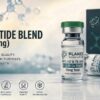
Buy Tesamorelin & Ipamorelin Blend (8mg)

$90.00
Buy the premium Tesamorelin & Ipamorelin Peptide Blend from Planex Supplies. This advanced dual-action research formulation pairs a stabilized, full-length GHRH analog with a highly selective ghrelin/growth hormone secretagogue receptor (GHS-R1a) agonist. Together, they are engineered to evaluate synergistic somatotroph cell kinetics, visceral adipocyte lipid mobilization, and musculoskeletal nitrogen retention. Every batch is independently USA-tested with transparent, documented Certificates of Analysis (COAs) to guarantee standard-setting laboratory integrity.
Advanced Dual-Action Pituitary Axis & Adipocyte Kinetics Research
The Tesamorelin & Ipamorelin Peptide Blend from Planex Supplies brings together two distinct molecular architectures widely studied for their concurrent, non-competitive activity within the mammalian endocrine matrix. By activating separate receptor families—the Growth Hormone-Releasing Hormone (GHRH) pathway and the Ghrelin/Growth Hormone Secretagogue Receptor (GHS-R1a)—this blend provides a non-redundant preclinical platform for investigating complex secondary messenger cascades, visceral versus subcutaneous adipose distribution, and temporal neuroendocrine feedback loops.
Comprehensive Technical Specifications:
Tesamorelin (N-Terminus & C-Terminus Modified Full-Length GHRH Analog)
- Molecular Formula: C₂₂₁H₃₆₆N₇₂O₆₇S
- Molecular Weight: 5136 g/mol
- Sequence: YADAIFTNSYRKVLGQLSARKLLQDIMSRQQGESNQERGARARL
- Alternative Designation: N-(trans-3-hexenoyl)-[Tyr1]hGRF(1–44)NH2 acetate
Ipamorelin (Highly Selective Pentapeptide GHS)
- Molecular Formula: C₃₈H₄₉N₉O₅
- Molecular Weight: 711.868 g/mol
- Sequence: Aib-His-D-2Nal-D-Phe-Lys
Key Areas of Scientific Research & Complementary Mechanisms:
- GHRH Receptor Conformation & cAMP-PKA Cascade: Tesamorelin features a 44-amino-acid structure stabilized with an N-terminal acetyl group and a C-terminal trans-3-hexenoic acid group (omega-amino acid modification) to resist rapid enzymatic degradation. Binding to class B GPCR GHRH receptors induces a conformational shift involving a large kink at TM6 to facilitate intracellular G-protein coupling. This upregulates the adenylate cyclase pathway, converting ATP to cyclic AMP (cAMP) and activating Protein Kinase A (PKA). Preclinical data links this cascade to a documented 69% increase in total growth hormone levels (AUC) and a 55% rise in average natural pulse amplitude.
- Phospholipase C Activation & Vesicular Exocytosis: Operating independently via the ghrelin axis, Ipamorelin binds with high specificity to GHS-R1a receptors in the anterior pituitary gland and hypothalamus. This interaction triggers a phospholipase C (PLC) signaling pathway, cleaving lipids into secondary messengers IP3 and DAG. IP3 prompts calcium ion (Ca²⁺) mobilization from intracellular stores, while DAG triggers Protein Kinase C (PKC) pathways. This independent surge in intracellular calcium forces the exocytosis of growth hormone-containing vesicles, driving secretagogue peaks up to 60-fold above baseline controls.
- Divergent Adipose Distribution & Lipodystrophy Modeling: Tesamorelin is actively scrutinized in models simulating lipodystrophy and visceral obesity, where it has demonstrated an ability to drive an approximate 25% reduction in deep visceral fat surrounding internal organs. Investigators leverage this lipolytic trait to explore improvements in downstream metabolic markers such as insulin resistance, hyperuricemia, and elevated LDL cholesterol. Conversely, Ipamorelin’s ghrelin-mimetic profile regulates hunger pathways, allowing researchers to study caloric intake, weight gain balances, and associated shifts in serum leptin levels.
- Musculoskeletal Quality & Nitrogen Homeostasis: Computed tomography (CT) cross-sectional profiles indicate that Tesamorelin exposure is linked to significant improvements in skeletal muscle density and structural cross-sectional area, showing reduced fat infiltration across the rectus abdominis, psoas major, and paraspinal muscle groups. Concurrently, Ipamorelin is monitored for its anti-catabolic properties within the hepatic architecture, where it assists in restoring nitrogen balance and diminishing excessive nitrogen wasting during states of induced catabolic stress.
The Planex Supplies Quality Standard
At Planex Supplies, we prioritize rigid analytical vetting to protect the replication standards of your laboratory findings. Our Tesamorelin + Ipamorelin blend is synthesized to high structural specifications and characterized via high-performance liquid chromatography (HPLC). Every batch is verified by independent, third-party laboratories in the United States and backed by fully accessible, documented Certificates of Analysis (COAs).
- Verified Purity: ≥ 99% purity guaranteed through mass spectrometry and HPLC profiling.
- USA Vetted: Rigorous independent batch evaluation ensures precise chemical identity, proper molecular weight, and complete freedom from cross-contaminants.
- Research Use Only: This compound is synthesized exclusively for in vitro laboratory experimentation and preclinical evaluation. Make sure to double-check the physical label to confirm this information.
Be the first to review “Buy Tesamorelin & Ipamorelin Blend (8mg)”
Related products

Peptide Blends
$84.00

Peptide Blends
$86.00
Peptide Blends
$81.00
Peptide Blends
$86.00
Peptide Blends
$80.00
Peptide Blends
$84.00

Peptide Blends
$87.00
Peptide Blends
$81.00
Reviews
There are no reviews yet.