
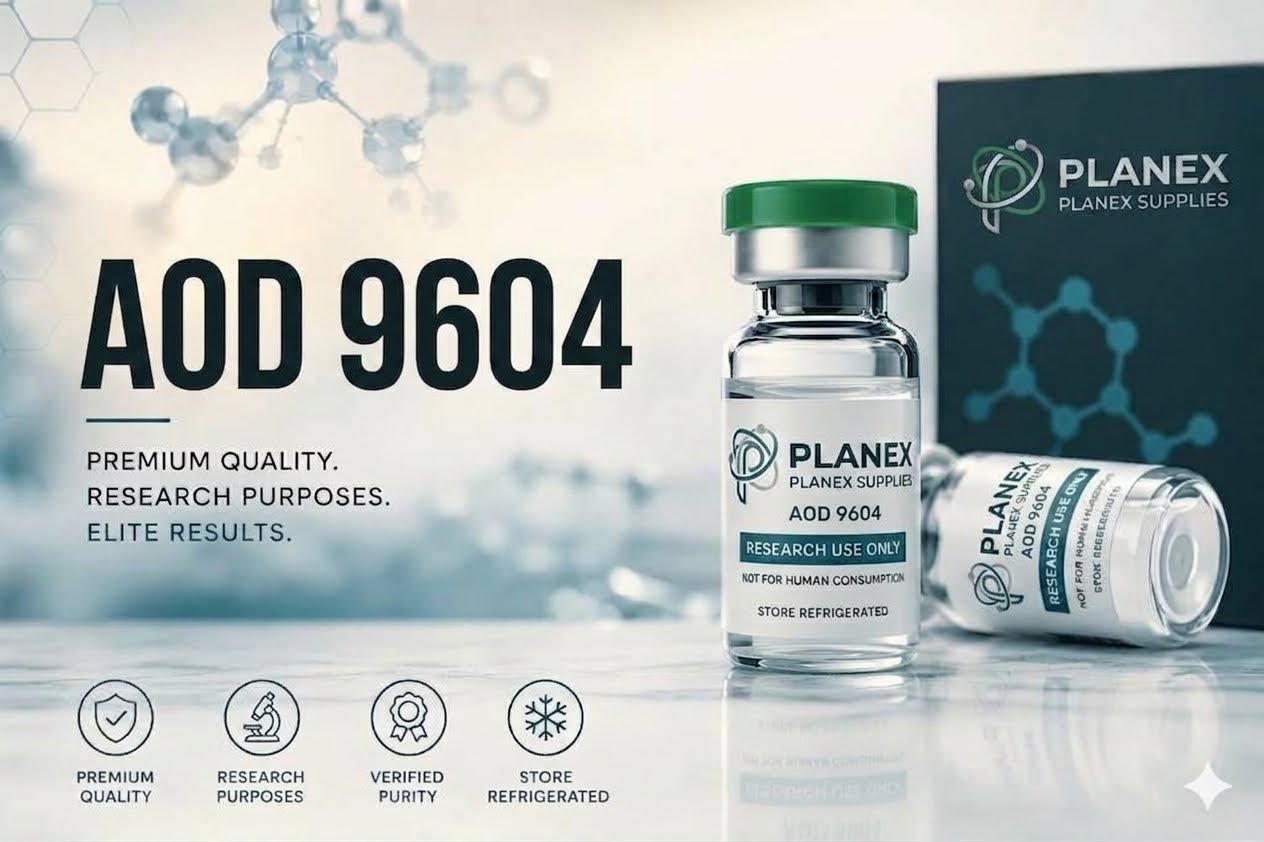
Buy AOD 9604 (5mg)
$44.00
Buy high-purity AOD 9604 Peptide from Planex Supplies. This advanced 16-amino-acid peptide is a stabilized structural modification of human growth hormone (hGH Fragment 176-191) engineered with an N-terminal tyrosine residue. Optimized for preclinical metabolic research, it allows investigators to study targeted lipolysis, beta-3 adrenergic receptor (\(\beta _{3}\)-AR) expression, and chondrocyte cartilage remodeling without altering systemic insulin sensitivity or inducing insulin-like growth factor-1 (IGF-1) cellular proliferation. Every batch is independently USA-tested with transparent, documented Certificates of Analysis (COAs) to guarantee standard-setting laboratory integrity.
Advanced Stabilized hGH C-Terminal Fragment for Metabolic Vetting
AOD 9604 (Advanced Obesity Drug-9604) is a highly specialized synthetic peptide engineered for advanced research into lipid metabolism, adipose tissue kinetics, and degenerative joint structures. Representing a critical breakthrough in growth factor isolation, AOD 9604 is a modified 16-amino-acid sequence derived from the C-terminus of the human growth hormone molecule (specifically residues 177-191). By appending a stabilized Tyrosine residue to the amino-terminus, researchers successfully isolated the primary lipolytic traits of full-length hGH while completely filtering out systemic growth-promoting and diabetogenic side effects.
Comprehensive Technical Specifications:
- Alternative Designations: AOD-9604, tyr-hGH 177-191, Lipolytic Fragment
- Molecular Formula: C₇₈H₁₂₃N₂₃O₂₃S₂
- Molecular Weight: 1815.1 g/mol
- Amino Acid Sequence: Tyr-Leu-Arg-Ile-Val-Gln-Cys-Arg-Ser-Val-Glu-Gly-Ser-Cys-Gly-Phe
Key Areas of Scientific Research & Mechanistic Profiles:
- Isolated Lipolysis and \(\beta _{3}\)-Adrenergic Sensitivity: Preclinical research reveals that AOD 9604 does not bind or interact with the native hGH receptor. Instead, it operates downstream by selectively triggering cellular pathways that force the release of free fatty acids from white adipose tissue (WAT). While it does not bind directly to \(\beta _{3}\)-adrenergic receptors, comparative studies demonstrate that AOD 9604 exposure significantly upregulates internal \(\beta _{3}\)-AR expression across white fat depots. This mechanism enhances lipolytic sensitivity and shifts lipid management cells from storage mode into a highly active metabolic state.
- Isolating Metabolic Paths from Anabolic Overgrowth: Full-length human growth hormone promotes fat burning but carries secondary traits like muscle cell proliferation (hypertrophy) and systemic tissue overgrowth via insulin-like growth factor-1 (IGF-1) upregulation. Preclinical murine models confirm that AOD 9604 lacks these associated anabolic traits, causing no change in lean mass index in lean models. Crucially, because it operates without triggering insulin resistance or reducing cell-wide glucose uptake, it serves as a highly specialized model for investigating fat cell reduction without inducing glucose intolerance or diabetes phenotypes.
- Lipase Modulation and Visceral Resorption Dynamics: Investigators leverage AOD 9604 to analyze how specific protein fragments modify the structural layout of fat cell matrices. Preclinical research suggests that the peptide alters the behavior of endogenous lipases—enzymes that dictate whether broken-down fat returns to adipose cells or is metabolized. In obese animal models, this action driven by massive concentrations resulted in a documented 28% reduction in total adipose tissue. These cellular insights have been further examined in Phase 2b clinical cohorts to evaluate long-term metabolic adaptations and cholesterol profile modifications.
- Chondrocyte Activation and Cartilage Matrix Remodeling: Beyond metabolic biology, a major emerging focus of AOD 9604 research lies within musculoskeletal and joint articulation fields. In animal models simulating osteoarthritis, local exposure to the peptide has been observed to mitigate movement disabilities and improve structural pain scores. Under microscopic structural analysis, the C-terminal fragment demonstrated an ability to promote chondrocyte proliferation and enhance joint cartilage regeneration—an impact that is optimized when administered alongside a hyaluronic acid (HA) delivery matrix.
The Planex Supplies Quality Standard
At Planex Supplies, we execute rigid analytical quality control to protect the precision and baseline replication standards of your scientific research. Our AOD 9604 peptide is synthesized to precise laboratory tolerances and verified using high-performance liquid chromatography (HPLC). Every single batch is independently tested within the United States and backed by accessible, documented Certificates of Analysis (COAs) to verify structural mass and exact compound concentration.
- Verified Purity: ≥ 99% purity guaranteed through mass spectrometry and HPLC profiling.
- USA Vetted: Independent laboratory confirmation ensures absolute consistency, correct amino acid sequence validation, and complete freedom from residual chemical cross-contaminants.
- Research Use Only: This compound is synthesized exclusively for in vitro laboratory experimentation and preclinical evaluation. Make sure to double-check the physical label to confirm this information.
Be the first to review “Buy AOD 9604 (5mg)”
Related products
$109.00

Peptides
$88.00

Peptides
$192.00
Peptide Blends
$115.00
Peptide Blends
$81.00

Peptides
$86.00

Peptides
Price range: $52.00 through $92.00

Peptides
$77.00
Reviews
There are no reviews yet.